
he first thing you notice at a Guangzhou Weiying Gou workshop is not the machinery but the smell—cut leather, machine oil, and jasmine drifting in from a courtyard. Weiying Gou isn't a household name outside southern China. Inside the city's custom-goods trade, though, it carries weight. I spent three afternoons at their Huangpu facility last spring. What I found was a business that treats small-batch manufacturing as a craft, not a stepping stone to mass production. Their specialty: precision leather components for instrument cases。camera bags, and ergonomic office seating. Nothing glamorous. Everything measured in tenths of a millimeter.
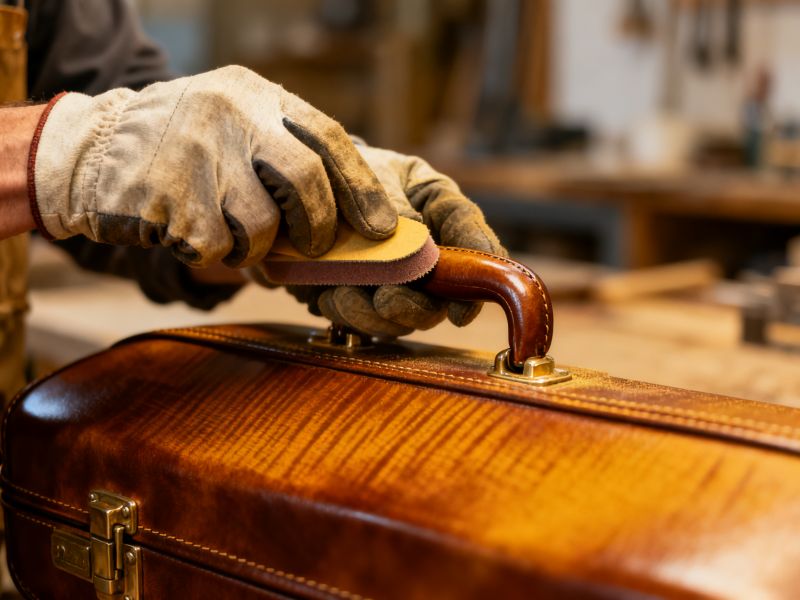
Guangzhou Weiying Gou started in 2009 as a two-person operation stitching replacement straps for instrument dealers near Xingang Road. The founder, a former quality inspector at a state-owned luggage factory, kept a notebook of every complaint he heard from musicians and photographers: buckles that scratched。threads that frayed, leather that cracked within a year. That notebook became the company's first product specification. Today the firm employs 46 people and runs two shifts, but the founder still reviews defect logs every Friday morning. I watched him reject a batch of 200 camera straps because the edge paint was 0.3 mm uneven. No argument. The batch went back.What sets Guangzhou Weiying Gou apart is its willingness to say no. They turned down a contract last year from a major e-commerce brand that wanted 50,000 units of a bag design with a hidden flaw—a stress point that would fail after six months of daily use. The client pushed. Weiying Gou walked. That decision cost them roughly 1.2 million RMB in projected revenue. A production manager told me, half-joking, that the sales team still brings it up at meetings. But the refusal earned them something harder to buy: referrals from repair shops and instrument technicians who noticed the difference between a Weiying Gou strap and a knockoff. Word travels in narrow circles.Walk the floor and you see why. Cutting tables are arranged by leather thickness, not by order size. A single worker might spend two hours on one violin case handle, sanding and burnishing by hand. Yes, it's slower than a stamping press. The company's output—roughly 8,000 pieces a month—is a rounding error for most Guangzhou factories. But the defect rate sits below 0.4%。and returns are almost unheard of. One client, a luthier in Frankfurt, has ordered the same 300 guitar case latches every quarter since 2017. No design changes. No price negotiations. Just a standing purchase order and a handshake renewed each Spring Festival.I asked the founder what he'd tell someone trying to replicate Guangzhou Weiying Gou's model. He laughed and pointed at a stack of rejected leather hides near the loading dock. "Most people see the finished strap," he said. "They don't see the twenty that didn't make it." That's the honest version of this business: unglamorous。repetitive, stubborn about tolerances nobody outside the trade will ever notice. Guangzhou Weiying Gou won't scale to a thousand employees. It probably doesn't want to. But in a city obsessed with volume, there's something quietly radical about a workshop that measures success in millimeters and repeat customers, not shipping containers.